

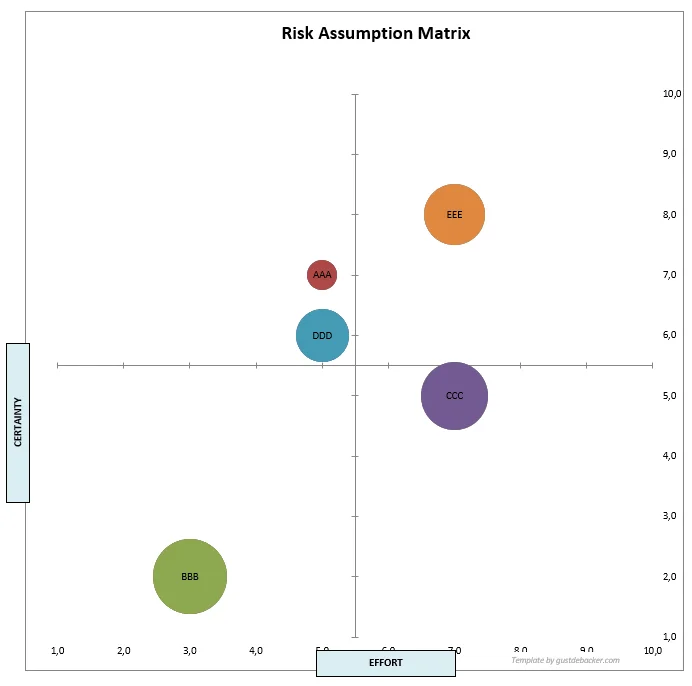



What is a Risk Assumption Matrix?
The Risk Assumption Matrix is a dynamic tool designed to provide a clear-sighted assessment of potential risks that could impact your project or organization. It organizes risks based on their likelihood of occurrence and potential impact, enabling the formulation of mitigation strategies that maximize success and minimize the potential damage from unanticipated situations.
This tool encourages an organization to explore assumptions and uncertainties, cultivating a more proactive approach to risk management. It bridges the gap between risk identification and risk response, providing you with a strategic advantage.
What is the outcome of a Risk Assumption Matrix?
Employing the Risk Assumption Matrix results in a comprehensive, holistic understanding of your risk landscape. It provides invaluable insights into potential risks, their likelihood, and potential impact, enabling you to prioritize your risk response efforts effectively.
Moreover, by leveraging this tool, your organization can become more proactive in its risk management, facilitating early detection and prevention of potential issues. This proactive stance can significantly increase your project’s resilience and agility, enhancing your capability to navigate challenges successfully.
Who is the Risk Assumption Matrix For?
The Risk Assumption Matrix is applicable across all industries and is particularly valuable to project managers, business leaders, and decision-makers. Its clear, organized format aids in visualizing potential risks, making it a vital instrument for strategic planning, risk management, and decision-making processes.
Whether you’re leading a startup, managing a project, or steering an established corporation, the Risk Assumption Matrix is an indispensable tool in your strategic arsenal.
How to Use a Risk Assumption Matrix?
To utilize a Risk Assumption Matrix effectively, follow these steps:
- Identify Potential Risks
Begin by identifying potential risks that could impact your project or organization.
- Analyze Risk Likelihood and Impact
Assess each risk based on its likelihood of occurrence and its potential impact on your project or organization.
- Prioritize Risks
Prioritize the risks based on their likelihood and impact. Risks with high likelihood and high impact should be prioritized.
- Develop Risk Responses
Formulate appropriate strategies or actions to mitigate each risk.
- Monitor and Review
Regularly review the matrix and update it as necessary to reflect changes in the risk landscape.
What Does it Take to Use a Risk Assumption Matrix?
Deploying a Risk Assumption Matrix requires time, understanding, and regular review. It’s not a one-off activity, but rather an ongoing process that should be integral to your project or business operations. The process requires involvement from key stakeholders, comprehensive understanding of the project or business, and a proactive mindset to anticipate potential risks.
Frequently Asked Questions
Regular updates to your Risk Assumption Matrix are essential. The frequency of these updates may depend on your specific project or business. However, a general rule of thumb is to review and update your matrix at least quarterly, or when any significant change occurs in your project or business environment.
When creating a Risk Assumption Matrix, it’s critical to involve all relevant stakeholders. Diverse perspectives can enhance the identification and understanding of potential risks. Moreover, be as detailed as possible when describing each risk, and ensure you accurately assess their likelihood and potential impact.
Absolutely! A Risk Assumption Matrix can be scaled to fit any project or business size. Even for small projects or businesses, it offers valuable insights into potential risks and aids in developing effective mitigation strategies.
While both tools are used in risk management, they serve different functions. A Risk Assumption Matrix is used to identify and analyze potential risks based on their likelihood and impact. On the other hand, a Risk Management Plan is a comprehensive document that outlines how risks will be identified, analyzed, monitored, and controlled throughout the lifecycle of a project.