


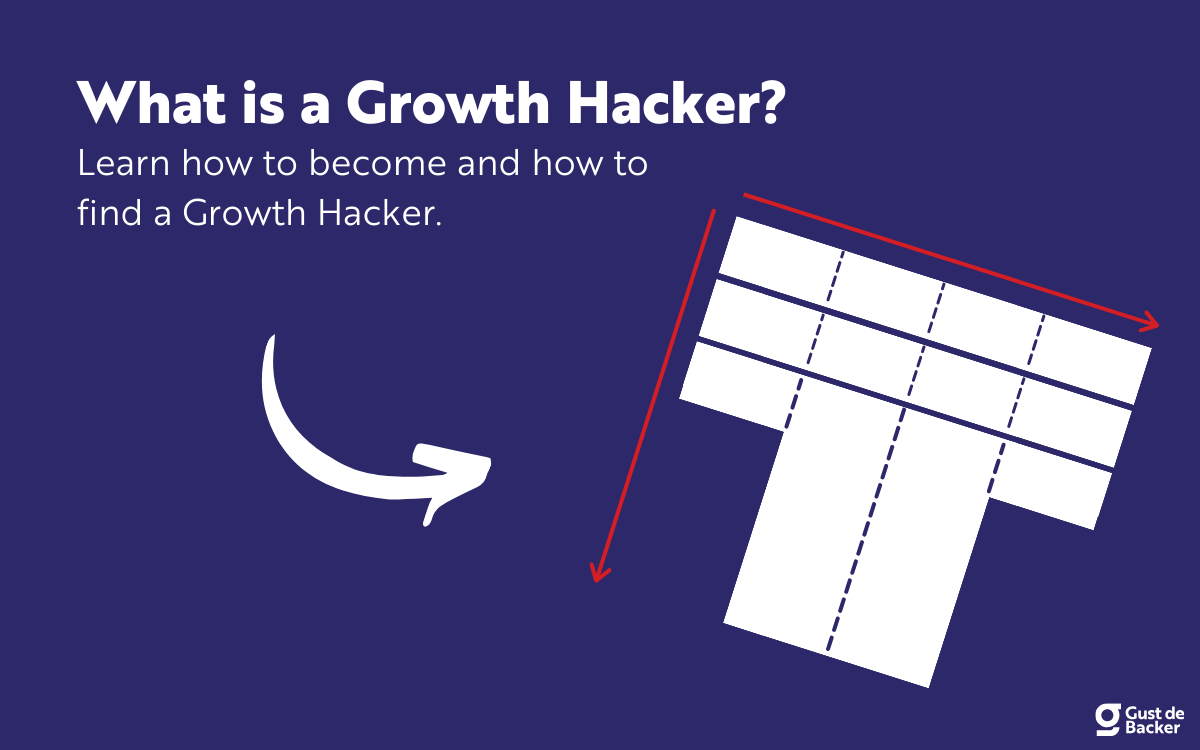
Growth Hacker, you don’t become one overnight.
In recent years, the term Growth Hacking has gained quite a bit of popularity and companies are constantly looking for so-called Growth Hackers….
But what’s it really like?
I’m going to explain to you:
- What a Growth Hacker / T-Shaped Marketer is.
- How to become a Growth Hacker.
- And how to find a Growth Hacker
Let’s get started…
What is a Growth Hacker?
A Growth Hacker is a marketer who focuses on growing a business effectively and efficiently using experiments.
The focus is not only on reaching and bringing in new customers, but also on the retention and referrals of existing customers. Thus, a Growth Hacker focuses on the entire funnel.
In addition, a Growth Hacker also influences the product to ensure that marketing is already built into the product.
As a Growth Hacker, you usually fall into one or at most two of the following disciplines:

Often you see someone being very technical and rational or very creative and emotional, hence the distinction.
What is a T-Shaped Marketer?
As a marketer, it is often not enough to specialize in one area, because the marketing landscape has become too large and fragmented for that…
As a T-Shaped Marketer, you possess three different levels of skills:

- Fundamental skills: understanding at a higher level why certain models and processes are deployed. Think about the G.R.O.W.S. process, the Pirate Funnel, Growth Hacking itself, etc.
- Generalist skills: you will need these skills in every task, think copywriting, A/B testing, formatting visuals, etc.
- Specialist skills: you can’t be a specialist in all specialist skills, but it’s good to specialize in certain areas. Think social media, SEO, SEA, CRO, etc.
The vertical line represents the depth that you have in a particular skill and the horizontal line represents your knowledge within different disciplines that you are not necessarily specialized in.
Why Become a Growth Hacker
There are several reasons why being a Growth Hacker allows you to make more impact than a traditional or a standard digital marketer:
- Full-funnel: as a Growth Hacker, you are not limited to reaching and bringing in new customers, but focus on the full pirate funnel and help improve the product.
- Starting point: as a Growth Hacker, you go data driven from the bottleneck instead of someone’s subjective opinion.
- Speed: the speed of a Growth Hacker is many times faster than that of standard marketers, because they work with experiments instead of big concepts that still require many rounds of feedback.
How do you become a Growth Hacker?
There are many different ways to become a Growth Hacker….
I’ll explain 1 path to you:
How to become a Growth Hacker?
- Learn the basics
First, it’s important to understand the models and processes. For example, read articles on the G.R.O.W.S. Process, the North Star Metric, the Pirate Funnel, Growth Hacking itself, etc.
- Delve into the generalist skills
Read about the most important skills you’ll need in (almost) every task you’ll face. For example, think about copywriting, behavioral psychology, Google Analytics, Hotjar, etc.
- Understand all the specialties
Make sure you can relate to all the specialties, know what they are for and know what opportunities fall within them.
- Get a mentor
Once you have gained all the knowledge it is important that you can actually apply this knowledge somewhere. Join a company where you have a mentor, someone with experience who can really help you advance in this field.
- Develop one or two specialties
If you are broadly trained, it is time to go deeper into one or two specialties so you can really add value in certain areas.
In addition, it is important that you have the right mindset:
Growth Hacking Mindset
As a Growth Hacker, it is important that you work according to certain principles:
- Speed over perfection: you want to validate assumptions as quickly as possible, according to the Pareto Principle, 80% of the output comes from 20% of the input. By being able to do more experiments you will also have more successful experiments at the end of the month.
- Be open to other problems and solutions: data doesn’t have all the answers, neither does your gut. Sometimes the solution is not in what is already there, but what is still missing. Try to ask as many why questions as possible to challenge your own hypotheses.
- Be data driven and challenge assumptions: what you cannot measure you cannot know. Assumptions can only be validated if you have data, so make sure everything is measurable as much as possible.
- Digital intelligence: innovation happens at an unprecedented pace:

By having a high digital intelligence you can quickly adapt to new (digital) circumstances. - Break silos: innovation, bottlenecks and ideas can come from any part of the organization, from support to engineering. A culture with fixated departments is killing Growth Hackers.
- Have respect for marketing: decisions are made based on emotion, it takes a mix of emotional and rational levers to really make a difference.
Growth Hacker Blogs
Some blogs you could start with as a Growth Hacker:
- Gustdebacker.com: content to effectively grow your business with growth hacking and business development.
- GrowWithWard: growth hacking related content, Ward was one of the first growth hackers in Europe.
- AndrewChen: practical insights from Andrew Chen, was responsible for the growth of Uber.
- Rockboost: growth hacking agency with content about growth hacking.
- GrowthHackers: community of growth hackers that organizes regular events.
- NeilPatel: big bucket of content with also several blogs about growth hacking.
- Reforge: several articles focused on growing a business. Also offer fairly pricey programs.
Growth Hacker Books
Books you can get started with:
- High Growth Handbook: book for going from startup to scale-up.
- Growing Happy Clients: book aimed at Growth consultants with useful tips and methods.
- Growth Engines: case studies of the most successful startups.
- Hacking Growth: well-known book by Sean Ellis, on the growth hacking methodology.
- Growth Hacker Marketing: another popular book, by Ryan Holiday on the principles of growth hacking.
- 100 days of growth: e-book by Sujan Patel, 100 ways to grow your business.
- Lean analytics: using data to build your startup faster and better.
- Don’t make me think: a book on usability on the web.
Growth Hacker Courses
Courses to get started:
- Growth Tribe: great range of courses for beginners and experts.
- CXL: fairly expensive, but good quality courses.
- Reforge: fairly large range of expensive, but quality programs.
- GrowthHackers: range of courses for beginners and experts.
How do you find a Growth Hacker?
There are a number of aspects that make it more interesting for a Growth Hacker to come work for you:
- Type: in general it is more interesting for a Growth Hacker to work on a digital product, because the results of this are measurable and directly visible.
- Data: if you have hardly any/no visitors on your website then the Growth Hacker will first have to deal with positioning and creating awareness. Not ideal circumstances, but what makes this an extra interesting challenge is to validate that there really is a problem and that the product solves it.
- Culture: a culture in which everything must first be approved by 5 people is killing for a Growth Hacker who wants to set up a lot of experiments quickly.
- Team: can changes to the website be made quickly or do we have to wait 3 weeks until someone finally has time to update the website?
- Opportunities for growth: is there enough room to learn new skills and seek new complexity?
Important to note here is that Growth Hacking by itself only makes sense if you have a Product-Market Fit. Otherwise, as a Growth Hacker, you will mainly be working on making the product fit the customer’s needs better.
What is the salary of a Growth Hacker?
A Growth Hacker in the US earns:
- Average $86,695 per year
Conclusion
So, now you have enough knowledge to become a Growth Hacker or set up your business to find one….
Now I’m curious, what do you think is the responsibility of a Growth Hacker?
Let me know in a comment.
P.S. Would you like additional help? Send me an email at [email protected]
Frequently Asked Questions
A Growth Hacker is a marketer who focuses on growing a business effectively and efficiently using experiments.
As a T-Shaped Marketer, you understand fundamental processes, have knowledge of fundamental marketing aspects, and specialize in 1-3 channels.
Learn the basics, understand why certain processes are the way they are. Next, immerse yourself in generalist skills to perform your tasks well. Finally, delve into 1-3 channels to become an expert in them.
To find a Growth Hacker, it is important that you have a company where a Growth Hacker wants to work. It’s useful to have a digital product, enough data to start working with, a culture where people can experiment quickly, people who can make changes quickly when needed and enough opportunities to grow.
Popular books are Growing Happy Clients, Hacking Growth, Growth Hacker Marketing and Lean Analytics.
Popular courses for Growth Hacking are the ones from Growth Tribe, CXL, Reforge and GrowthHackers.com.
You don’t need to be able to code to become a Growth Hacker, it can be helpful to be able to set up experiments quickly.
Well known Growth Hackers include Sean Ellis (former Dropbox & LogMeIn), Noah Kagan (SumoMe & OkDork), Nir Eyal (Nirandfar.com), Andrew Chen (former Uber), Sujan Patel, Neil Patel and Brian Dean.

![BCG Matrix (2026): Meaning and Example [+ Template]](https://gustdebacker.com/wp-content/uploads/2023/11/BCG-Matrix.png)
![Lean Canvas (2026): How-to & Examples [+ Template]](https://gustdebacker.com/wp-content/uploads/2023/11/Lean-Canvas.png)
![Revenue Models (2026): 19 Different Ways to Make Money [B2B & B2C]](https://gustdebacker.com/wp-content/uploads/2023/11/Revenue-Models.png)

I don’t think the title of your article matches the content lol. Just kidding, mainly because I had some doubts after reading the article.