


The SWOT Analysis is a tool for identifying your company’s strengths, weaknesses, opportunities and threats….
Every marketer is familiar with SWOT and more or less familiar with it.
However, the problem with the standard SWOT Analysis is that it doesn’t have action items associated with it and gets lost somewhere on the drive or in the archives.
I’m going to explain to you:
- What a SWOT Analysis and Confrontation Matrix are
- Why you should do this analysis
- And how to set up a SWOT Analysis and Confrontation Matrix
Let’s get started…
What is a SWOT Analysis?
The SWOT Analysis, also known as strength-weakness analysis, is a strategic marketing tool often used to see how strong a company is in the marketplace.
The SWOT Analysis shows at a glance where the opportunities for your company lie and where you need to pay extra attention:

So in this you look at:
- Internally (factors of your business):
- Strengths
- Weaknesses
- External (factors outside your company):
- Opportunities
- Threats
Ultimately, you can use the SWOT Analysis to determine the marketing strategy for your company.
What is a Confrontation Matrix?
The difference between the SWOT Analysis and Confrontation Matrix is that the SWOT Analysis shows the strengths, weaknesses, opportunities and threats where the Confrontation Matrix shows the relationship between these elements.
The Confrontation Matrix ensures that the SWOT Analysis can actually be put into action by prioritizing and mapping relationships so that ultimately a score per item is going to come out after which a marketing strategy can be formulated:

In this case, we have only contrasted strengths with opportunities, but we are still going to cover all the components separately.
Questions that confrontation matrix answers:
- How can we make the most of our strengths?
- How can we make the most of our weaknesses?
- How can we make the most of external opportunities?
- How can we best deal with external threats?
Ultimately, one of the following marketing strategies emerges from this:
- Aggressive
- Conservative
- Competitive
- Defensive
How do you complete a SWOT Analysis?
There are 4 steps to go through when completing a SWOT Analysis, you start with the internal issues and then work to the external issues:

Download the canvas and complete it at the same time using the steps below:

Internal analysis
You start with a micro-level (internal) analysis, you will research the following components:
- 7Ps: map within which component of your company the competitive advantage lies, alternatively you can fill in the SIVA model.
- Marketing: examine how well the marketing and sales department functions and how strong your brand is.
- Customers: divide your customers into a customer pyramid to understand the different types of customers in your business.
- MABA Analysis: analyze your product portfolio.
- Treacy and Wiersema: map out different disciplines of your business.
- Finance: map your company’s financial position.
- Organization: identify your company’s strengths and weaknesses.
With this, you can then identify your company’s strengths and weaknesses
1. Map strengths of your company
Apple example:

2. Examine what your company’s weaknesses are
Apple example:

External analysis
Now for the external factors, you’re going to do a study at the meso or macro level, which is about the entire industry or sector….
…at the macro level, you go even a step further and examine the entire market.
Then you end up with the following components:
- Macro environment: investigate to what extent the macro environment affects your company and industry. This can already be done using a DESTEP Analysis or the Porter 5 Forces model.
- Industry: research the developments and trends in your industry, these can also be legal or political.
- Customers: map the different segments of your market, for example with the TAM SAM SOM Canvas.
- Competition: do a competitive analysis mapping not only direct competitors, but also indirect competitors.
- Distribution: analyze the distribution channels of your product or service and the marketing function of those distribution channels.
- Competitive Strategy Porter: evaluate how best to add distinctiveness to your business.
The result of this external analysis will ultimately then be the opportunities and threats to your business
3. Identify external opportunities in the marketplace
Apple example:

4. Do critical research on threats in the marketplace
Apple example:

Common mistakes made in a SWOT Analysis
There are several mistakes that are often made in a SWOT Analysis:
- One common mistake you see is that the SWOT Analysis is not completed at the same level of abstraction. For example, certain points may be very much at the level of detail where other points are filled in very globally.
- Falsely labeling strengths and weaknesses as opportunities and threats keeps internal and external separate.
- Stop after completing the SWOT Analysis, continue with the confrontation matrix after the SWOT Analysis.
- The SWOT Analysis should also not be completed with 1 person, but with several people within the company.
- Difference in the number of items is too big which can have a negative effect on the strategy.
How to complete a confrontation matrix?
The confrontation matrix is where the market and business come together; it is the basis of the strategic marketing plan.
The SWOT Analysis serves as input for the confrontation matrix and the outcome of the confrontation matrix are the relationships between the different SWOT Analysis points.
1. Weight the SWOT points
Prioritize the various points from your SWOT Analysis, then assign a decimal number to each point based on the prioritization with the total per box eventually coming out to 1:

2. Fill in SWOT-TOWS 8 times
Next, you are going to fill in the SWOT-TOWS model (confrontation matrix) 8 times…
- Do strengths help you take advantage of opportunities?
- Do opportunities help improve your strengths?
- Do weaknesses make threats worse?
- Do threats make weaknesses worse?
- Do strengths help reduce threats?
- Do threats cause strengths to become weaker?
- Do weaknesses reduce opportunities?
- Do opportunities reduce weaknesses?
3. Find connections
Go through each section to see if one point affects the other point, if so put a 1 in the box and otherwise a 0. See example above.
4. Calculate SWOT-TOWS
To finally arrive at scores, it is necessary to do the number of interactions times the weighting to arrive at a score:
What you also see in this is that the number of interactions and the total weighting are added together.
5. Determine the marketing strategy
Take all the accumulated weightings and interactions for each box and fill it in the sheet below:
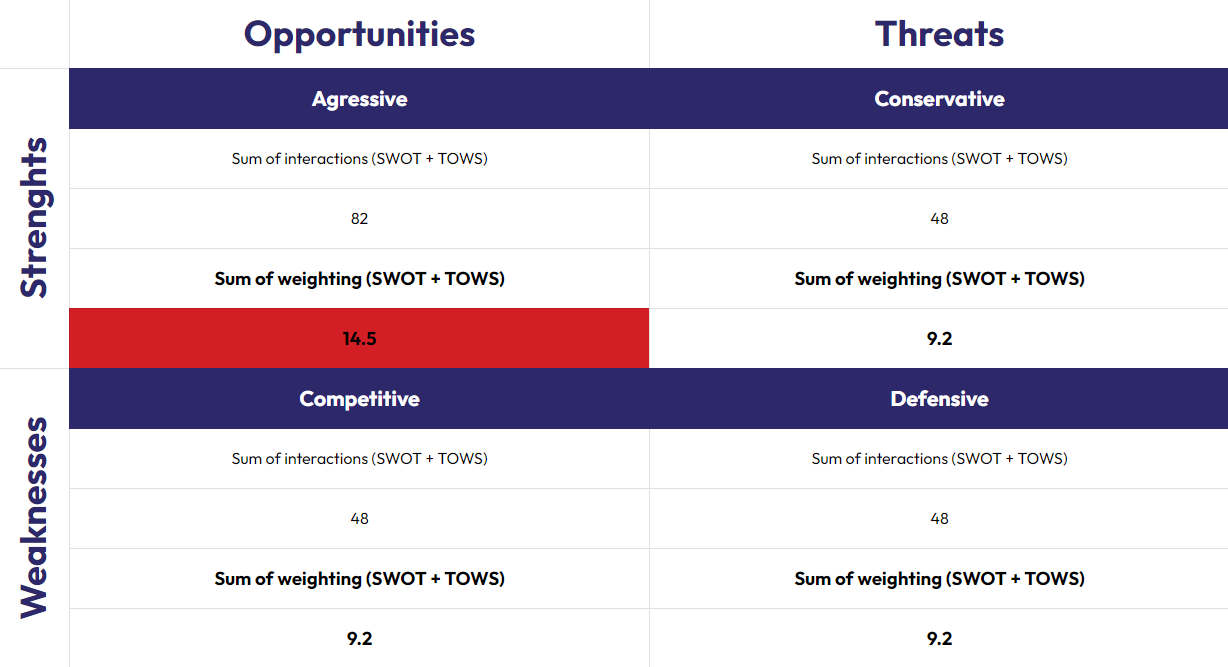
The subject with the highest weighting becomes your marketing strategy, if you have the same weighting in several subjects you take the subject with the most interactions.
6. Get to work on high priorities
Establish an OGSM canvas with the items that have an interaction and high weighting from your profession in order to put them into strategic planning so that the findings actually turn into actions.
Some examples of strategies
Aggressive strategy (letting the company do what it does best when opportunities arise):
- Enter new markets
- Increase sales in existing markets
- Develop new products
- Invest in brand awareness
- Increase loyalty
- Increase employee loyalty
- Increase production
Competitive strategy (the company will try to take on an opportunity without necessarily having its strengths here):
- Increase current market share
- Become active in less demanding markets
- Diversify product portfolio
- Hire staff with market knowledge
- Increase cooperation with parent company
Conservative strategy (letting the company play into its strengths to turn threats into opportunities):
- Reduce seasonality
- Shift warehousing costs to intermediaries
- Optimize product deliveries
- Reduce prices for certain product
- Reduce risk
Defensive strategy (the company is in a market where there are many external threats where it does not have the competencies to start acting against them):
- Slowly pulling out of the market
- Reduction of activities
- Minimizing losses
- Reducing costs
- Sell the company
Ansoff Matrix
The different marketing strategies look familiar to the Ansoff Matrix:

Common mistakes in a confrontation matrix
There are several mistakes that are common in a confrontation matrix or SWOT-TOWS model:
- One of the main mistakes is that there is a lot of subjectivity involved. Ideally, everything should be grounded in data, but inefficiencies may have crept in. In that case, it is important to look at the SWOT Analysis with several people and fill out the sheets again.
- Using the wrong level of abstraction in the SWOT Analysis can have a big impact on the final marketing strategy that is chosen.
Are you going to formulate a marketing strategy?
Now I want to know from you…
How do you formulate your marketing strategy?
Let me know in the comments.
P.S. if you would like additional help regarding this topic, let me know at [email protected]
Frequently Asked Questions
In a SWOT Analysis, you are going to look at internal and external factors. The internal factors are the strengths and weaknesses of your company and the external factors are the opportunities and threats in the market.
A good SWOT Analysis includes an extra step where you are going to contrast your findings to determine which marketing strategy you are going to pursue and which items you are going to work on first. You can do that using a SWOT-TOWS analysis or Confrontation Matrix.
A SWOT Analysis consists of the strengths and weaknesses of your company and the opportunities and threats in the market.

![BCG Matrix (2026): Meaning and Example [+ Template]](https://gustdebacker.com/wp-content/uploads/2023/11/BCG-Matrix.png)
![Lean Canvas (2026): How-to & Examples [+ Template]](https://gustdebacker.com/wp-content/uploads/2023/11/Lean-Canvas.png)
![Revenue Models (2026): 19 Different Ways to Make Money [B2B & B2C]](https://gustdebacker.com/wp-content/uploads/2023/11/Revenue-Models.png)
0 Comments